Indian mythology has always been deeply connected with storytelling. For thousands of years, stories of gods, sages, cosmic events, devotion, sacrifice, transformation, and spiritual wisdom have been passed from one generation to another through scriptures, temples, folk traditions, music, dance, theatre, paintings, and oral narratives.
Today, technology is creating a completely new way to experience these stories.
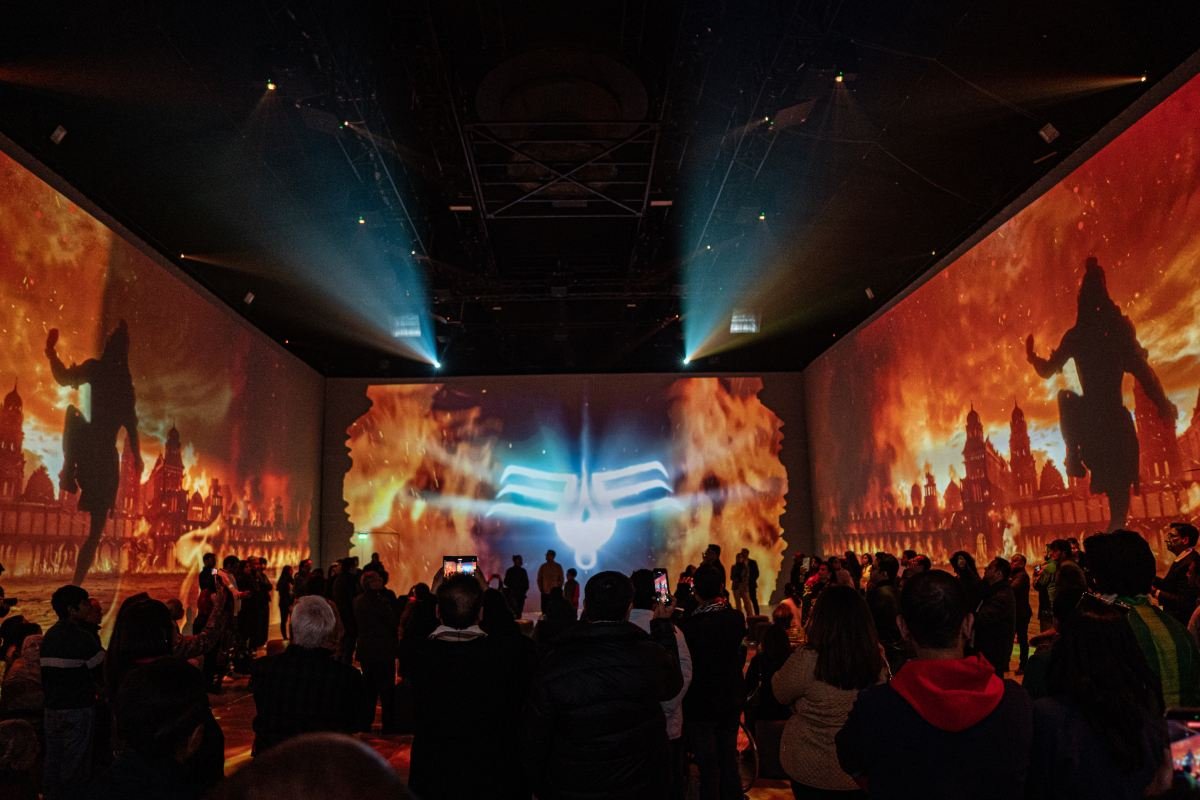
Shiva Immersive is an example of this transformation. Instead of presenting the story of Lord Shiva through a conventional film, stage performance, or exhibition, the experience surrounds visitors with large-scale visuals, spatial sound, lighting, atmospheric effects, virtual reality, and specially designed environments.
The official Shiva Immersive website describes it as a large-format immersive storytelling experience where stories are designed to be seen, felt, and experienced rather than simply watched. The current experience is located at GIP Mall in Noida.
What Makes Shiva Immersive Different From a Regular Show?
A traditional movie places the audience in front of a screen. A theatre performance generally places performers on a stage while the audience watches from a fixed direction.
Shiva Immersive takes a different approach.
The audience enters a specially designed environment where visuals can appear around them. Sound is designed to work with the surrounding space, while lighting, projection, atmospheric effects, and other technologies contribute to the storytelling.
This means the audience does not simply observe a story from a distance.
The environment itself becomes part of the story.
That is what makes immersive entertainment different from conventional visual entertainment.
A Journey Through the World of Shiva
The experience is built around the mythology and symbolism associated with Lord Shiva.
Shiva is one of the most complex and fascinating figures in Indian spiritual traditions. He is associated with meditation, transformation, destruction, creation, cosmic consciousness, devotion, balance, and the union of seemingly opposite forces.
These themes provide enormous opportunities for visual and sensory storytelling.
A concept such as cosmic energy can be difficult to explain through ordinary dialogue. But through scale, movement, sound, darkness, light, animation, and visual effects, creators can attempt to communicate the feeling behind the concept.
This is one of the major creative opportunities offered by immersive storytelling.
The Three-Part Experience
The current Shiva Immersive experience is structured around three major zones: the Immersive Experience, VR Experience, and Reflection Zone. The official ticketing information describes the complete journey as approximately 60 minutes.
Each section serves a different purpose.
The first stage creates visual and sensory impact.
The second takes visitors into a virtual reality journey connected with Kailash.
The final stage slows the experience down and provides a quieter environment for reflection.
This progression gives the experience a beginning, middle, and emotional conclusion.
Entering the Immersive Zone
The Immersive Zone is the central visual component.
According to the official description, visitors spend roughly 25–30 minutes inside a large immersive environment where 360-degree projection, spatial sound, lasers, lighting, and haze work together.
Instead of viewing a single screen, visitors are surrounded by the visual world.
This can make the scale of the storytelling feel significantly larger.
A landscape can appear to stretch across the walls. Cosmic imagery can expand around the audience. Light can change the atmosphere of the room. Sound can complement movement on screen.
The result is intended to create a cinematic environment rather than simply a cinematic image.
How 360-Degree Projection Changes Storytelling
One of the biggest differences between traditional cinema and immersive storytelling is the visual field.
A normal cinema screen has clear boundaries.
In a 360-degree environment, those boundaries become much less obvious.
This gives creators an opportunity to control the audience’s sense of scale and space.
A scene can begin in darkness and gradually fill the entire environment with light. A landscape can surround visitors. Abstract patterns can move across the walls. Cosmic imagery can create a feeling of enormous scale.
For mythology, this approach can be particularly powerful because many traditional stories involve celestial worlds, cosmic events, mountains, rivers, divine forms, and symbolic landscapes.
The Importance of Sound in Shiva Immersive
Visuals alone cannot create a complete immersive experience.
Sound is equally important.
Shiva Immersive uses spatial sound and an original musical score as part of its production. The soundscape works together with the visual environment to create emotional transitions and a stronger sense of presence.
Music has always played an important role in Indian storytelling.
Devotional music, classical traditions, chants, instruments, and rhythm have historically been used to create atmosphere and emotion.
An immersive production can combine these traditions with modern sound design.
This creates an interesting bridge between familiar cultural elements and contemporary technology.
The Role of Lighting and Atmospheric Effects
Immersive experiences depend on more than projection screens.
Lighting can change the mood of an environment within seconds.
A bright scene can create excitement and energy, while darkness can create mystery, anticipation, or stillness.
Shiva Immersive also incorporates lasers and atmospheric effects such as haze, helping projected light become part of the physical environment.
These elements can make digital imagery feel more connected to the physical surroundings.
Instead of watching special effects from a distance, visitors can feel as though they are standing inside an environment created by those effects.
The Kailash VR Experience
The VR portion provides a completely different form of immersion.
The official experience describes this section as a virtual exploration of Kailash. The VR journey allows visitors to explore a representation of the sacred landscape through virtual reality technology.
Virtual reality is particularly interesting for cultural storytelling because it can simulate places that are difficult, remote, inaccessible, or impossible to experience in ordinary circumstances.
Rather than simply looking at a picture of a mountain, the visitor can enter a digitally created environment and explore it through a headset.
This transforms observation into participation.
Why Mount Kailash Is Important to the Experience
Mount Kailash has a deep connection with Shiva traditions and is one of the most significant sacred landscapes associated with him.
For many people, physically reaching such a location is extremely difficult.
The VR experience therefore provides a technology-driven interpretation of a landscape that carries enormous spiritual and cultural significance.
It is not a replacement for the real-world location.
Instead, it represents a different form of storytelling that allows visitors to experience an artistic and technological interpretation of the place.
The Reflection Zone
After the visual spectacle and VR journey, Shiva Immersive moves into a quieter stage.
The Reflection Zone is designed around stillness and contemplation. The official website describes an environment resembling an infinite field of stars surrounding a glowing cosmic centre.
This creates an important contrast.
The earlier parts of the experience focus heavily on movement, technology, sound, visuals, and scale.
The Reflection Zone reduces that intensity.
The visitor is given an opportunity to pause.
This transition reflects one of the most recognizable associations with Shiva: meditation and stillness.
Why Reflection Is Important in Immersive Design
A common mistake in immersive entertainment can be assuming that more technology always creates a better experience.
In reality, constant stimulation can become overwhelming.
Good experience design often depends on contrast.
A loud moment becomes more powerful after silence. A bright visual becomes more striking after darkness. A fast sequence can feel more dramatic when followed by stillness.
The Reflection Zone uses this principle by providing a calmer ending after the main spectacle.
Shiva Immersive and Indian Mythology
One of the most interesting aspects of Shiva Immersive is its attempt to connect traditional mythology with contemporary entertainment.
Young audiences today consume stories through films, animation, gaming, streaming platforms, social media, virtual reality, and interactive media.
Immersive storytelling provides another format through which cultural narratives can be introduced.
Instead of asking younger audiences to learn mythology only through books or traditional formats, experiences like Shiva Immersive can provide an audiovisual and interactive entry point.
Making Ancient Stories Relevant to Modern Audiences
Ancient stories can remain relevant when their themes continue to connect with contemporary audiences.
Shiva’s stories contain themes of transformation, devotion, resilience, balance, identity, sacrifice, family, meditation, and cosmic order.
These themes are not limited to one historical period.
Modern technology simply provides a new language through which these ideas can be explored.
This is why the combination of mythology and immersive technology is particularly interesting.
Shiva Immersive as an Example of Experience Design
Shiva Immersive is also an excellent example of experience design.
Experience design focuses on how people feel and behave throughout an entire journey.
The creators are not simply designing visuals.
They have to consider the visitor’s arrival, movement through the venue, transition between zones, sound environment, lighting, seating, technology, storytelling, pacing, and emotional conclusion.
Every part contributes to the overall memory of the experience.
The Creative Team Behind the Production
A production of this scale requires a multidisciplinary team.
The official team information identifies Samit Garg as creator and director, with Jai Thakore and Sonali Thakore as co-producers and Manika Garg as co-producer and creative collaborator. The wider team includes specialists working in VFX, architecture, music, sound design, writing, production, brand design, and strategy.
This range of expertise demonstrates that immersive storytelling is not the work of a single creative discipline.
It combines elements of filmmaking, theatre, architecture, technology, music, design, production, and cultural research.
The Role of Visual Effects
Visual effects are another major component of the experience.
The official team lists Adrian Corsei as VFX Supervisor, with experience on major international film productions.
Large-scale immersive storytelling requires visual content to work across a very different environment from conventional cinema.
The visuals have to be designed for large surfaces and multiple viewing directions.
This creates technical and artistic challenges that require specialized knowledge.
Architecture Becomes Part of the Story
In a normal cinema, the building is mostly a container for the screen.
In an immersive environment, architecture can become part of the storytelling.
The dimensions of the room, wall surfaces, ceiling, lighting positions, audience placement, circulation, and acoustics can influence how the story is perceived.
The official team includes architect Abhishek Kamboj, whose work spans culturally significant public spaces, hospitality, and immersive environments.
This highlights how spatial design is integrated into the production.
The Role of the Voice
Narration can help audiences understand complex mythological themes.
The official Shiva Immersive team lists actor Sharad Kelkar as the voice associated with the production.
A recognizable and expressive voice can provide continuity as the audience moves through different visual environments.
It can also help connect the technological spectacle with the storytelling tradition.
Shiva Immersive in Noida
The current official information places Shiva Immersive at GIP Mall, Sector 38, Noida, Uttar Pradesh, with entry through Gate 9. The official site currently lists daily operating hours from 12:30 PM to 8:30 PM and an approximate experience duration of 60 minutes.
The experience is indoors and the venue is wheelchair accessible according to the official information.
Because event dates and availability can change, visitors should check the official website before planning their visit.
Ticket Options for Shiva Immersive
The experience currently offers different formats, including an immersive-only option, an immersive experience combined with VR, and a package including the immersive, VR, and reflection components.
The listed starting price is currently around ₹799, although actual ticket prices can vary depending on the selected package, date, and availability.
Booking in advance is recommended because specific sessions can have limited capacity.
Is Shiva Immersive Suitable for Families?
The official website states that all age groups are welcome and that children under five can enter free under the stated conditions.
The experience can therefore appeal to families looking for something different from a traditional movie or shopping-centre activity.
Children may particularly enjoy the large-scale visuals and VR component, while adults may be interested in the mythology, storytelling, technology, and atmosphere.
What Should Visitors Expect During the Experience?
Visitors should expect a seated, indoor experience rather than a conventional walking museum.
The official information states that chairs are available and that the experience is designed to last approximately one hour.
The audience moves through the different stages of the experience while remaining within carefully designed environments.
There is no conventional interaction with performers.
The focus is on visual storytelling, technology, sound, atmosphere, and personal immersion.
Important Things to Know Before Visiting
The official website notes that strobe lighting is used during the experience. Visitors who are sensitive to flashing lights should take this into account before booking.
The venue is wheelchair accessible, while certain large bags, tripods, outside food and beverages, and other restricted items are not permitted inside the experience areas.
Mobile photography is permitted under the venue’s stated conditions, provided other visitors are not disturbed.
Why Shiva Immersive Is Interesting for Designers
For designers, Shiva Immersive provides an opportunity to study how different creative disciplines can work together.
The project combines visual communication, spatial design, storytelling, technology, sound, lighting, architecture, branding, and audience psychology.
Instead of designing one object, creators are designing an entire journey.
This is a key difference between traditional design projects and large-scale experience design.
Why Marketers Can Learn From Shiva Immersive
Marketing is increasingly moving toward experiences.
Brands are creating pop-up stores, immersive exhibitions, interactive campaigns, experiential events, digital installations, and physical environments designed for social sharing.
Shiva Immersive demonstrates how storytelling can become an environment.
A brand can similarly move beyond advertisements and create something people can physically enter, explore, photograph, discuss, and remember.
The Experience Economy and Shiva Immersive
People increasingly spend money not only on products but also on experiences.
Concerts, travel, theme parks, exhibitions, immersive art, cultural attractions, restaurants, festivals, and experiential retail are all part of this broader movement.
Shiva Immersive fits into this experience economy by turning mythology into an environment that visitors actively enter.
The value is therefore not only in the story itself but also in the way the story is experienced.
Can Immersive Technology Preserve Cultural Stories?
Technology can sometimes be criticized for making traditional stories feel overly commercial or disconnected from their origins.
The challenge for creators is maintaining cultural sensitivity while creating something contemporary.
Shiva Immersive attempts to address this by combining research, narrative development, music, visual storytelling, architecture, and technology.
The balance between authenticity and innovation is likely to remain one of the most important questions for future cultural experiences.
The Future of Mythology-Based Experiences
India has an enormous collection of stories that could potentially be explored through immersive technology.
Stories from the Ramayana, Mahabharata, Puranas, regional folklore, Buddhist traditions, historical kingdoms, temple cultures, and local legends could all potentially be presented through digital environments.
The challenge will be creating experiences that are visually impressive while remaining culturally meaningful.
Shiva Immersive provides an example of how this balance can be approached.
Why People May Remember Shiva Immersive
People often remember experiences through particular emotional moments.
A huge visual transformation may create awe.
A powerful piece of music may create emotion.
A VR journey may create curiosity.
A quiet reflection space may create calm.
These individual moments can combine into a larger memory.
That is ultimately the goal of experience design: creating something that remains in people’s minds after they have left the venue.
Frequently Asked Questions About Shiva Immersive
What is Shiva Immersive?
Shiva Immersive is a large-format immersive storytelling experience inspired by the mythology of Lord Shiva. It combines 360-degree projection, spatial sound, lighting, lasers, atmospheric effects, virtual reality, and a reflection environment.
Where is Shiva Immersive located?
The current official location is GIP Mall, Sector 38, Noida, Uttar Pradesh, with entry through Gate 9.
How long is the Shiva Immersive experience?
The complete experience takes approximately 60 minutes across its different zones.
What are the different zones in Shiva Immersive?
The experience includes the Immersive Zone, VR Zone, and Reflection Zone.
Does Shiva Immersive include virtual reality?
Yes. The VR section takes visitors on a virtual journey associated with Mount Kailash.
Is Shiva Immersive a movie?
No. It is an immersive storytelling experience rather than a conventional movie. The audience is surrounded by projections, sound, lighting, and environmental effects.
Is Shiva Immersive suitable for children?
The official website states that all age groups are welcome, with specific provisions for children under five.
Is Shiva Immersive indoors?
Yes. The official information describes the experience as an indoor venue.
Is the venue wheelchair accessible?
Yes. The official website states that the venue is wheelchair accessible.
Is there strobe lighting?
Yes. The official FAQ states that strobe lights are part of the experience.
Who created Shiva Immersive?
Shiva Immersive was created and produced by E-Factor Experiences Limited. Samit Garg is identified as the creator and director.
What is the main idea behind Shiva Immersive?
The central idea is to present the world and mythology of Shiva through an immersive environment where visitors can experience the narrative through visuals, sound, technology, atmosphere, and reflection.
Conclusion
Shiva Immersive represents a fascinating meeting point between ancient Indian mythology and modern experiential technology.
Instead of presenting Shiva’s story only through books, television, cinema, or conventional theatre, the production creates an environment where visitors can experience mythology through 360-degree visuals, spatial sound, lighting, atmospheric effects, VR, and reflection.
Its three-stage structure is particularly interesting because it moves from spectacle to exploration and finally toward stillness.
The experience also demonstrates how cultural storytelling can evolve without abandoning its traditional foundations. Technology becomes a tool for creating a new relationship between audiences and stories that have existed for generations.
For families, culture enthusiasts, technology lovers, designers, marketers, tourists, and people interested in immersive entertainment, Shiva Immersive offers a different way to encounter the world of Lord Shiva.
Ultimately, the experience raises a powerful question about the future of storytelling: What happens when we stop simply watching a story and begin to step inside it?
Shiva Immersive attempts to answer that question by turning mythology into an environment where story, technology, sound, space, emotion, and imagination come together.