
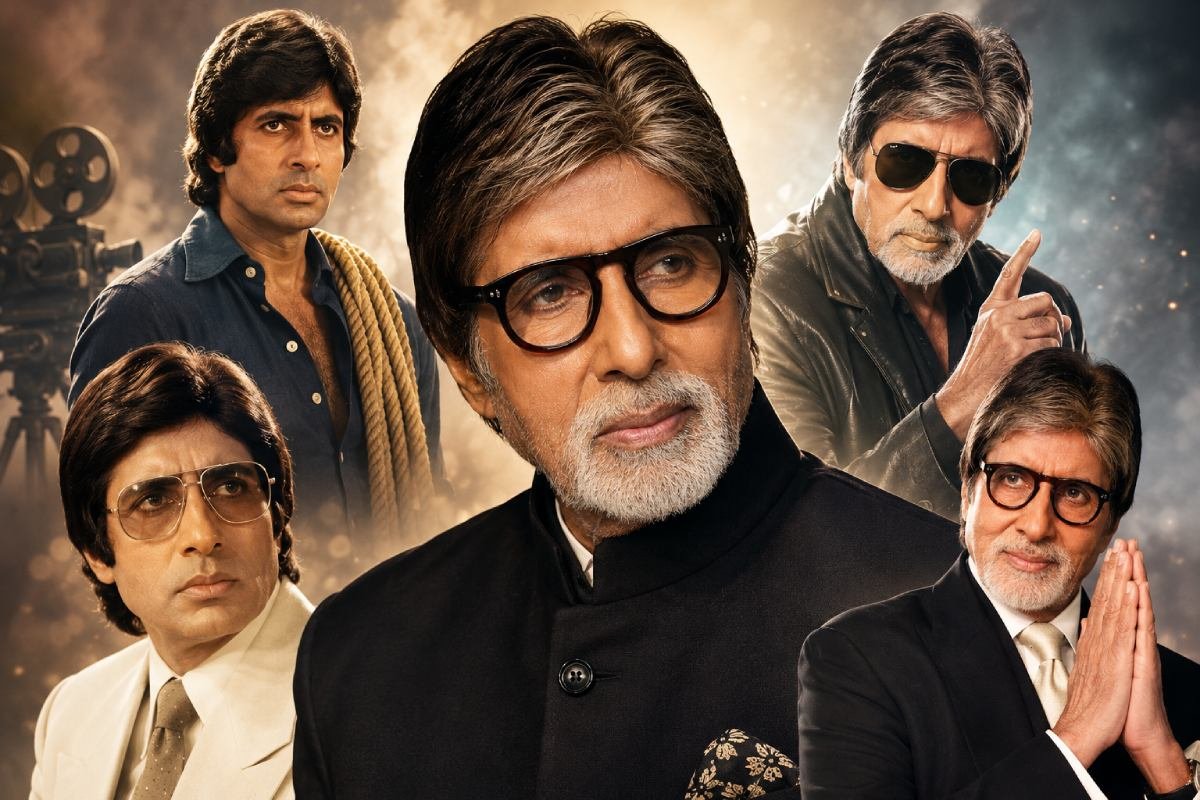
Amitabh Bachchan is one of the most celebrated personalities in Indian cinema. Known for his powerful voice, commanding screen presence, memorable dialogue delivery, and remarkable versatility, he has remained an important part of Hindi entertainment for more than five decades.
From struggling to find opportunities in the early years of his career to becoming one of the biggest stars in Indian cinema, Amitabh Bachchan’s journey is filled with remarkable achievements, difficult periods, comebacks, and reinvention. His career has extended beyond films into television, production, narration, and public life.
Born on October 11, 1942, in Allahabad, British India, now Prayagraj, Uttar Pradesh, Amitabh Bachchan grew up in a literary family. His father, Harivansh Rai Bachchan, was a renowned Hindi poet, while his mother, Teji Bachchan, was involved in social and cultural activities.
Early Life and Family Background
Amitabh Bachchan was born as Amitabh Harivansh Bachchan. His childhood was influenced strongly by literature because of his father’s career as a celebrated poet.
His family environment exposed him to Hindi language, poetry, culture, and public performance from an early age. He also has a younger brother, Ajitabh Bachchan.
Amitabh attended Sherwood College in Nainital before pursuing higher education at Delhi University. After completing his studies, he worked in Kolkata before deciding to pursue his ambition of becoming an actor.
The Beginning of His Acting Career
Amitabh Bachchan entered the Hindi film industry at a time when becoming a successful actor was extremely competitive.
He made his film debut with Saat Hindustani in 1969. The movie did not become a major commercial success, but Amitabh’s performance helped him gain recognition among filmmakers.
His distinctive deep voice also became an important part of his identity. Although his physical appearance and unconventional voice were initially not considered typical for a leading Bollywood hero, those same qualities eventually became some of his greatest strengths.
Anand and Recognition as an Actor
One of the early films that helped Amitabh gain greater recognition was Anand, directed by Hrishikesh Mukherjee.
In the film, Amitabh played Dr. Bhaskar Banerjee, a serious and reserved doctor opposite Rajesh Khanna. His performance earned him the Filmfare Award for Best Supporting Actor.
The role demonstrated that he could create a strong screen presence without necessarily being the central romantic hero.
Zanjeer and the Birth of the Angry Young Man
The major turning point in Amitabh Bachchan’s career came with Zanjeer.
Released in the early 1970s, the film presented Amitabh as Inspector Vijay Khanna, a serious and determined police officer. His performance was different from the romantic heroes who dominated Hindi cinema at the time.
The success of Zanjeer helped establish Amitabh as a major star and contributed to the creation of his famous “angry young man” image.
This image connected with audiences who identified with stories involving corruption, injustice, unemployment, poverty, and frustration.
Deewaar Strengthened His Superstar Image
Deewaar became another defining film in Amitabh Bachchan’s career.
His portrayal of Vijay Verma presented a complicated character caught between family responsibilities, ambition, crime, and morality.
The film’s powerful writing and Amitabh’s intense performance helped establish him as an actor who could portray emotionally complicated characters.
The combination of his deep voice, controlled expressions, physical presence, and dialogue delivery became a distinctive feature of his performances.
Sholay and a Historic Partnership
Few films in Indian cinema have achieved the cultural impact of Sholay.
Released in 1975, the film featured Amitabh Bachchan as Jai and Dharmendra as Veeru. Their friendship became one of the most recognizable partnerships in Hindi cinema.
Amitabh’s portrayal of Jai was relatively restrained compared with Dharmendra’s more expressive Veeru. His quiet personality, dry humor, and emotional depth made Jai an unforgettable character.
Sholay became a landmark in Indian popular culture and played a major role in establishing Amitabh as one of the country’s biggest stars.
The Versatility of Amitabh Bachchan
Although Amitabh became famous for action and intense dramatic roles, his career cannot be limited to one genre.
He demonstrated his comic abilities in films such as Amar Akbar Anthony and explored romance, family drama, crime, comedy, and emotional storytelling through movies such as Kabhie Kabhie, Muqaddar Ka Sikandar, Silsila, and Don.
This versatility allowed him to appeal to different sections of the audience and prevented his career from becoming dependent on one particular character type.
Don and the Dual-Role Performance
Don gave Amitabh Bachchan an opportunity to portray two contrasting characters.
He played the sophisticated criminal Don as well as Vijay, an ordinary man who becomes involved in the story.
The difference between the two characters allowed Amitabh to demonstrate his ability to change his body language, voice, mannerisms, and personality.
The film became one of his most remembered works and its character later inspired a new generation of filmmakers.
Amitabh Bachchan’s Famous Voice
Amitabh Bachchan’s baritone voice has become one of the most recognizable voices in Indian entertainment.
His voice has been used in film narration, documentaries, advertising, television, and other forms of storytelling.
His ability to deliver dialogue with authority and emotion made his voice an important part of his star identity.
Even when he is not visible on screen, his voice can often immediately identify him to Indian audiences.
The Coolie Accident
A major turning point in Amitabh Bachchan’s personal life occurred during the filming of Coolie in 1982.
He suffered a serious injury while performing an action sequence. The incident resulted in a prolonged hospitalization and generated enormous concern among his fans throughout India.
His recovery became a national event, with millions of people following news about his condition.
The episode demonstrated the extraordinary emotional connection that audiences had developed with him.
Amitabh Bachchan and Politics
During the 1980s, Amitabh Bachchan temporarily entered Indian politics.
He contested a Lok Sabha election and won a parliamentary seat. However, his political career was relatively short, and he eventually resigned from Parliament.
His brief political involvement remains an interesting chapter in a career otherwise dominated by cinema and entertainment.
Challenges During the 1990s
The 1990s were a difficult period for Amitabh Bachchan.
After dominating Hindi cinema for much of the previous two decades, his films were no longer achieving the same level of commercial success.
He also became involved in film production through Amitabh Bachchan Corporation Ltd. The business faced serious financial difficulties, adding another challenge to his career.
However, these setbacks did not end his journey. Instead, they became part of a much larger story of professional reinvention.
Kaun Banega Crorepati and a Historic Comeback
Amitabh Bachchan experienced one of the most remarkable career transformations when he became the host of Kaun Banega Crorepati.
The Indian adaptation of Who Wants to Be a Millionaire? began airing with Amitabh as host in 2000.
His sophisticated yet approachable hosting style became one of the show’s biggest attractions. He interacted with contestants, asked questions with dramatic timing, and created emotional connections with ordinary participants.
The success of KBC introduced Amitabh to younger audiences and significantly strengthened his public presence.
Reinventing Himself as a Character Actor
After his television comeback, Amitabh made an important career decision.
Rather than attempting to compete with younger actors for conventional romantic-lead roles, he embraced mature and character-driven performances.
Movies such as Mohabbatein, Kabhi Khushi Kabhie Gham, Baghban, Black, Sarkar, Cheeni Kum, and Paa demonstrated how successfully he could reinvent himself.
This transition became one of the most important reasons for his longevity.
Black and a Critically Acclaimed Performance
Sanjay Leela Bhansali’s Black provided Amitabh with one of the most challenging roles of his later career.
He portrayed Debraj Sahai, a teacher who works with a young woman who has difficulty seeing, hearing, and communicating.
The performance required emotional intensity as well as physical and behavioral transformation.
The film was widely appreciated and reinforced Amitabh’s reputation as a serious performer capable of taking on unconventional roles.
Paa and Another Transformation
In Paa, Amitabh took on the role of a young boy affected by a rare genetic condition.
The role required extensive makeup and physical transformation.
Instead of relying on his established superstar image, he accepted the challenge of portraying a character dramatically different from himself.
The performance became another example of his willingness to experiment even after decades of success.
Amitabh Bachchan as a Producer
Amitabh Bachchan has also explored the business side of entertainment.
His production company experience during the 1990s gave him an opportunity to participate in filmmaking beyond acting.
Although the business faced significant financial difficulties, the experience showed his willingness to take professional risks.
His career therefore includes acting, television, production, narration, advertising, and other entertainment-related activities.
Amitabh Bachchan’s Awards and Honours
Amitabh Bachchan has received some of India’s most prestigious entertainment and civilian honors.
He received the Padma Shri in 1984, the Padma Bhushan in 2001, and the Padma Vibhushan in 2015. The Government of India’s official Padma Awards records list him as a Padma Vibhushan recipient in the field of Art.
He was also selected for the Dadasaheb Phalke Award, India’s highest cinema honor. The award was presented to him by President Ram Nath Kovind at Rashtrapati Bhavan in December 2019.
His recognition reflects both his enormous popularity and his long-term contribution to Indian cinema.
Amitabh Bachchan and Television
Television became an important part of Amitabh Bachchan’s second career.
Through Kaun Banega Crorepati, he developed a hosting style that was different from his film persona. He could be serious, humorous, emotional, encouraging, and conversational within the same episode.
The show also demonstrated his ability to connect with ordinary people rather than only movie audiences.
His television work helped prove that established film stars could successfully transition between different forms of entertainment.
Amitabh Bachchan’s Family
Amitabh Bachchan is married to actress Jaya Bachchan. They married in 1973 and have two children, Abhishek Bachchan and Shweta Bachchan.
Abhishek Bachchan followed his father and mother into the film industry and became an actor.
The Bachchan family has remained one of the most recognizable families in Indian entertainment, with their professional achievements and public appearances receiving considerable attention.
His Relationship With His Fans
Amitabh Bachchan has developed an unusually strong relationship with his audience.
For generations of Indian viewers, he has been present through cinema, television, advertising, public events, and digital platforms.
His ability to remain connected with audiences despite changes in technology and entertainment consumption has contributed to his continued relevance.
He has also embraced social media and digital communication, allowing him to communicate directly with fans and share personal observations, photographs, and professional updates.
Amitabh Bachchan’s Influence on Indian Cinema
Amitabh’s influence extends beyond his individual performances.
During the 1970s, he helped redefine the image of the Hindi film hero. Instead of portraying only romantic and idealized characters, he represented anger, frustration, rebellion, and social dissatisfaction.
His success influenced the types of characters that filmmakers created for male leads.
His dialogue delivery, hairstyle, clothing, action style, and mannerisms also became influential elements of popular culture.
Why Amitabh Bachchan Is Called the Big B
The nickname “Big B” became closely associated with Amitabh Bachchan because of his enormous stature in Indian cinema.
He has remained one of the most recognizable Indian actors internationally and has built a career that spans multiple generations.
His longevity is particularly remarkable because the Hindi film industry has changed dramatically since he began acting in the late 1960s.
His Ability to Reinvent Himself
Perhaps the most important lesson from Amitabh Bachchan’s career is his ability to reinvent himself.
He moved from supporting roles to leading man, from action hero to romantic actor, from superstar to political figure, from producer facing business difficulties to television host, and from conventional hero to acclaimed character actor.
Each stage presented different challenges, yet he continued to find new ways to remain professionally relevant.
Amitabh Bachchan in Contemporary Cinema
Amitabh Bachchan has continued to work in major film and entertainment projects even after reaching an age at which many actors would have significantly reduced their professional activities.
His later career has included character roles, special appearances, narration, television, and projects aimed at modern audiences.
His continued presence demonstrates that an actor’s career does not necessarily have to follow a traditional rise-and-fall pattern.
The Legacy of Amitabh Bachchan
Amitabh Bachchan’s legacy is built on more than box-office success.
It includes his contribution to acting, dialogue delivery, television, narration, popular culture, and the changing image of the Hindi film hero.
His career has included extraordinary success as well as periods of professional and financial difficulty. What distinguishes his story is the ability to return stronger after setbacks.
For millions of people, Amitabh Bachchan represents determination, professionalism, reinvention, and the enduring power of cinema.
Frequently Asked Questions About Amitabh Bachchan
When was Amitabh Bachchan born?
Amitabh Bachchan was born on October 11, 1942, in Allahabad, now known as Prayagraj, Uttar Pradesh.
What was Amitabh Bachchan’s first movie?
His acting debut was Saat Hindustani, released in 1969.
Which movie made Amitabh Bachchan a superstar?
Zanjeer was a major breakthrough and helped establish him as one of the leading stars of Hindi cinema.
Why is Amitabh Bachchan called the Angry Young Man?
During the 1970s, he frequently played characters who were frustrated with corruption, injustice, poverty, and social inequality. These roles created his famous “angry young man” image.
What is Amitabh Bachchan’s most famous television show?
He is strongly associated with Kaun Banega Crorepati, the Indian version of Who Wants to Be a Millionaire? He began hosting the show in 2000.
Who is Amitabh Bachchan’s wife?
Amitabh Bachchan is married to actress Jaya Bachchan.
Who are Amitabh Bachchan’s children?
He has two children, Abhishek Bachchan and Shweta Bachchan.
What are some of Amitabh Bachchan’s famous movies?
Some of his best-known films include Zanjeer, Deewaar, Sholay, Don, Amar Akbar Anthony, Muqaddar Ka Sikandar, Agneepath, Mohabbatein, Black, Sarkar, and Paa.
What is Amitabh Bachchan’s biggest award?
Among his most prestigious honors is the Dadasaheb Phalke Award, which was presented to him in 2019.
Which civilian awards has Amitabh Bachchan received?
He has received the Padma Shri, Padma Bhushan, and Padma Vibhushan for his contribution to the arts. The official Padma Awards records list his Padma Vibhushan in 2015.
Conclusion
Amitabh Bachchan’s biography is a story of extraordinary ambition, talent, struggle, success, setbacks, and reinvention.
From his early years and first film Saat Hindustani to the revolutionary success of Zanjeer and Sholay, he became one of the defining stars of Hindi cinema. His later transition into television and character-driven cinema proved that a successful career can continue evolving rather than simply ending with the decline of a particular era.
His powerful voice, memorable performances, professionalism, and ability to connect with audiences have made him a unique figure in Indian entertainment.
More than five decades after his film debut, Amitabh Bachchan remains a symbol of Indian cinema and an example of how talent combined with persistence and adaptability can create a truly enduring legacy.